
Mood Swings That Feel Bigger Than the Moment: What Might Be Driving Them

Reviewed by Dr. Peter Wannigman, ND, Licensed Naturopathic Doctor and former pharmacist, one of California's inaugural licensed NDs (2004). Reviewed September 2026.
You snapped at someone over something small, and you knew even as it was happening that the reaction did not match the moment. Or you went from fine to flattened in the space of an afternoon, for no reason you can point to. If you have started wondering whether something is "wrong" with you, or whether you are just stressed, tired, or "being dramatic," you are not alone, and it is a fair question to want answered properly instead of guessed at.
Mood swings get filed into one of two boxes very quickly: a mental health conversation, or "it's probably hormones." Both can be true, and neither is the whole picture. A root-cause approach starts by asking what else might be contributing before assuming either box is the full answer.
Mood Swings and "It's Probably Hormones": Why That Doesn't Feel Like a Real Answer
Hearing "it's probably hormones" from a doctor who is moving on to the next patient is not the same as having someone actually look at what your hormones, blood sugar, sleep, and thyroid are doing. Standard visits are short, and a general reassurance that mood shifts are common is not incorrect, but it also is not an investigation. A root-cause approach treats "it's hormones" as the start of a question, not the end of one.
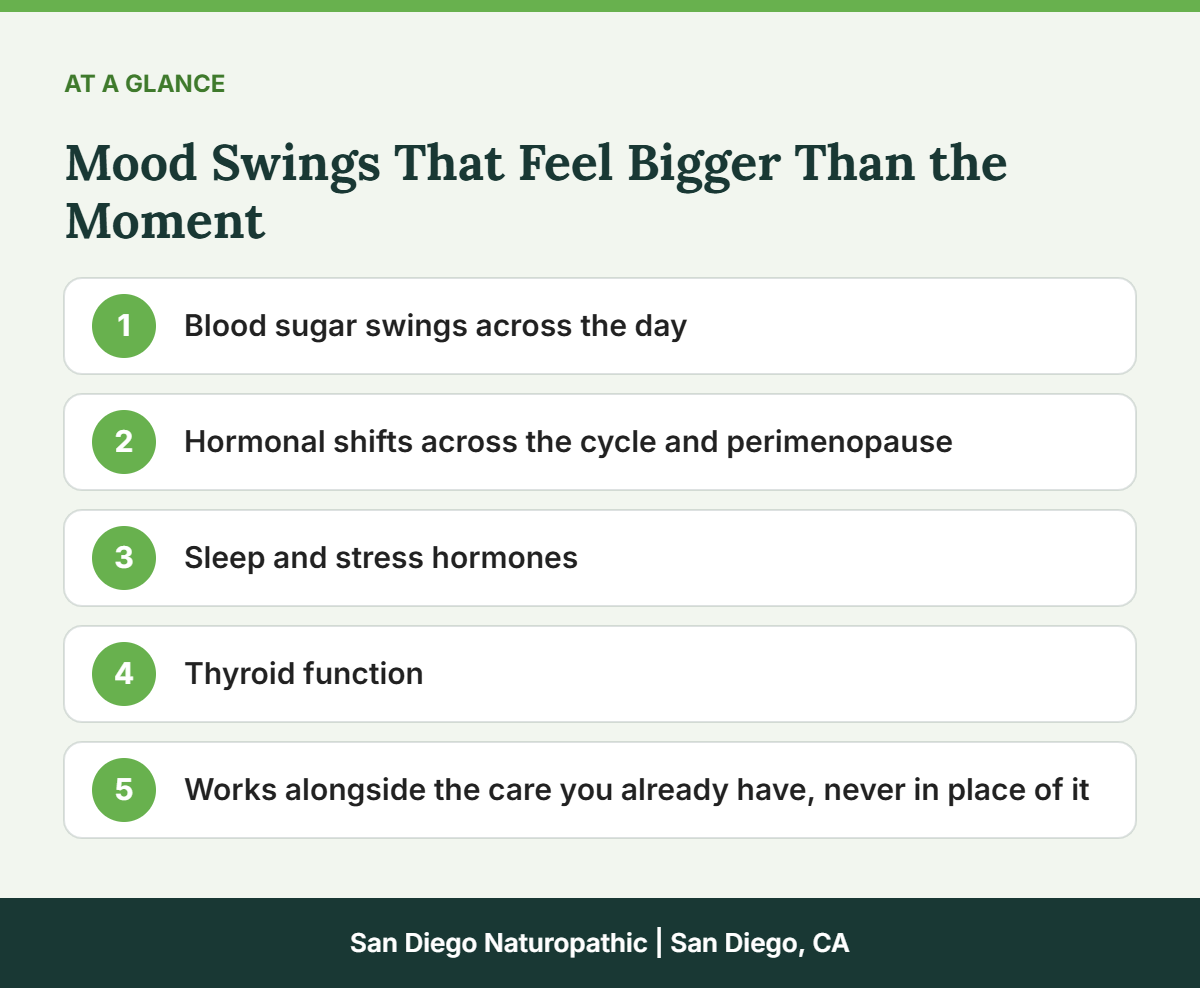
The Physical Side of Mood: What a Root-Cause Look Considers
Blood Sugar Swings
When blood sugar rises and falls sharply across the day, the body responds with stress hormones meant to bring it back into range, and those same hormones affect mood, irritability, and focus. A pattern of energy crashes, followed by irritability or anxious energy, followed by another crash, is worth mapping against actual eating patterns and blood sugar regulation rather than treating as a personality trait or a willpower problem.
Hormonal Shifts Across the Cycle and Perimenopause
Estrogen and progesterone both influence mood-related brain chemistry, and their ratio shifts predictably across a monthly cycle and less predictably during perimenopause. A root-cause evaluation looks at where a person is in that transition and what the actual hormone pattern looks like, rather than treating "perimenopause" as a single explanation that ends the conversation.
If perimenopause may be part of your picture, our guide on how to talk to your doctor about perimenopause can help you prepare for that conversation, and the hormonal picture behind PCOS covers a related pattern.
Sleep and Stress Hormones
Cortisol, the body's primary stress hormone, follows its own daily rhythm, and chronic short sleep or high ongoing stress can flatten or disrupt that rhythm in ways that show up as mood instability rather than obvious fatigue. This is often the most overlooked piece, because a person can look "fine" on paper while their stress-hormone pattern is genuinely out of rhythm.
Thyroid Function
Both an underactive and an overactive thyroid can produce mood symptoms, ranging from flat and low to irritable and on edge, and thyroid symptoms can be easy to miss when a panel checks only TSH. A broader look at thyroid function is a standard part of investigating unexplained mood changes.
A Virtual, Unhurried Conversation From San Diego and Beyond
For someone in San Diego juggling a job, a commute, and the logistics of getting to yet another appointment, a rushed ten-minute slot is often the only kind of medical time available for a concern like this. Doc Wanni's practice is delivered entirely virtually across San Diego and Southern California, which removes the scheduling and travel barrier that keeps a lot of people from ever getting a longer, unhurried conversation about a symptom like mood swings in the first place.
That matters here specifically because mood-related symptoms rarely have a single, obvious cause, and sorting out blood sugar, hormones, sleep, and thyroid from each other takes more than a few minutes. A virtual visit does not shorten that conversation the way an in-person slot squeezed between other patients often does.
What This Approach Adds, and What It Does Not Replace
A root-cause look at mood swings is meant to add a physical-systems lens alongside whatever care you already have in place, not instead of it. If what you are experiencing looks or feels like it could be a mental health condition, meaning persistent low mood, loss of interest in things you normally enjoy, intrusive worry, or thoughts of self-harm, that deserves its own evaluation by a therapist, psychiatrist, or your primary care physician, and this approach is not a substitute for that evaluation. Many people benefit from both: continuing therapy or psychiatric care for the mental health side, while also investigating whether blood sugar, hormones, sleep, or thyroid function are adding to the picture. This practice coordinates with, and never in place of, any mental health or medical care you already have.
It also is not a substitute for your primary care physician's ongoing management of any diagnosed condition. If you are already being treated for a thyroid disorder, a mood disorder, or a hormonal condition, this evaluation is meant to sit alongside that care and give you and your existing providers more information to work with, not to second-guess a diagnosis you already have or suggest changing a treatment plan on your own.
You can read more about how the practice approaches this on our mood swings condition page.
What a Discovery Call Conversation Looks Like
A free 15-minute discovery call is a conversation, not a commitment. It is a chance to describe what you have been noticing, ask what a broader look at the physical side of mood might involve, and decide together whether it makes sense to go further. Book a free discovery call if you want to talk through what might be contributing to what you are feeling.
If you would rather learn about the overall approach before talking to anyone, the free wellness webinar walks through how a root-cause evaluation works in general, at your own pace.
If this pattern sounds familiar
A free discovery call is a straightforward way to talk through what you are noticing and whether a deeper look at the physical side of mood makes sense for you.
Book a Free Discovery CallFrequently Asked Questions
Can blood sugar really affect mood, or is that oversimplified?
It is a real physiological connection. Blood sugar swings trigger stress hormones that also affect mood and irritability, which is why energy crashes and mood crashes often travel together. It is one contributing factor among several, not the whole explanation on its own.
Are mood swings during perimenopause different from PMS?
Both involve shifting estrogen and progesterone, but perimenopause involves a longer, less predictable hormonal transition rather than a monthly pattern. The symptoms can look similar, which is exactly why it helps to look at where someone actually is in that transition rather than assuming either label automatically applies.
When should mood swings be evaluated as a possible mental health condition instead of, or alongside, a physical workup?
If mood changes come with persistent low mood, loss of interest in things you usually enjoy, ongoing intrusive worry, or any thoughts of self-harm, that deserves its own evaluation by a therapist, psychiatrist, or your primary care physician. A physical-systems look can run alongside that care, but it is not a substitute for it.
Does a root-cause approach replace therapy or psychiatric care?
No. This approach looks at physical contributors like blood sugar, hormones, sleep, and thyroid function, and it is intended to work alongside any therapy, counseling, or psychiatric care you already have, never in place of it. If you are not currently connected with a mental health provider and think you might need one, that conversation is worth having with your primary care physician too.
What does a typical evaluation for mood-related symptoms include?
A conversation about your history, symptom patterns, sleep, stress, and cycle if relevant, along with a discussion of which lab markers might be worth reviewing given what you describe. The specific tests recommended vary by person, so a discovery call is the place to talk through what might apply to your situation.
Information on this website is for educational purposes only and is not a substitute for medical advice, diagnosis, or treatment. A practitioner-patient relationship is not established until formally accepted by the practice.