Hair Loss, Acne, and Irregular Cycles: The Androgen Connection
Reviewed by Dr. Peter Wannigman, ND, Licensed Naturopathic Doctor and former pharmacist, one of California's inaugural licensed NDs (2004). Reviewed September 2026.
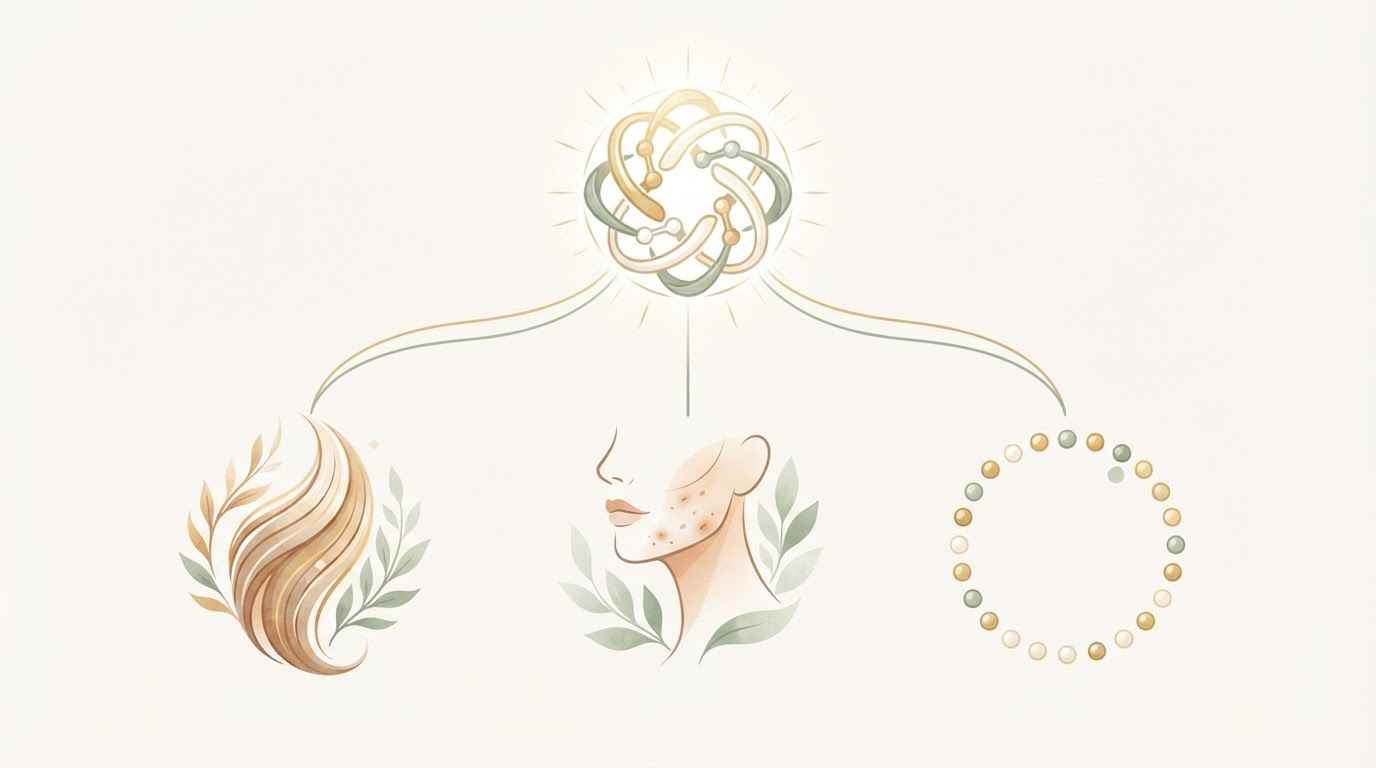
Your hair has been thinning near your part. Your skin, which mostly behaved in your twenties, is breaking out along your jaw. Your cycle has gone from predictable to erratic. On their own, each of these might get written off as stress, a new skincare product, or just getting older. Together, they are worth a second look, because there may be one hormonal thread running through all three.
That thread is often androgen imbalance, a pattern that gets far less attention than it deserves, in part because each symptom tends to get sent to a different specialist instead of being looked at as a set.
When Separate Symptoms Turn Out to Be Connected
It is a common experience: a dermatologist for the acne, a hairstylist's guess for the thinning hair, and a shrug for the irregular periods, with nobody connecting the three. That fragmentation is not anyone's fault. It reflects how conventional care is often structured around individual symptoms rather than the systems underneath them. A root-cause approach starts from the opposite direction, by asking what single system could plausibly be producing all of these symptoms at once.
What Androgens Are (and Why "High" or "Low" Both Matter)
Androgens are a category of hormones, including testosterone and DHEA-S, that everybody's body produces, women included, in smaller amounts than men. They play a normal role in libido, muscle, mood, and skin. Problems tend to show up when androgen levels run higher than what a woman's body is used to, or when the balance between androgens and other hormones shifts, not because androgens are inherently a "male" hormone gone wrong.
The Symptom Cluster a Root-Cause Look Pays Attention To
Hair Changes
Thinning at the crown or part line, sometimes alongside increased hair growth on the face, chin, or jawline, is one of the more visible patterns associated with androgen shifts. It is easy to treat this as purely cosmetic, but the pattern itself is useful diagnostic information.
Skin and Acne
Hormonally driven acne tends to cluster along the jawline and chin, often worsens around certain points in the cycle, and can persist into adulthood well past the teenage years typically associated with breakouts. This pattern is different from acne that responds mainly to topical skincare changes.
Cycle Changes
Cycles that become irregular, unusually long, unpredictable, or accompanied by other changes can be one more piece of the picture. Cycle changes have many possible causes, so this symptom on its own is not diagnostic, but combined with hair and skin changes, it adds meaningful context.
Androgen Excess and PCOS Are Related, But Not the Same Thing
Polycystic ovary syndrome, or PCOS, is one well-known condition where androgen excess plays a role, and our article on the hidden root problem of PCOS goes deeper into that specific picture. But androgen imbalance can occur without a PCOS diagnosis, and not everyone with this symptom cluster has PCOS. The two overlap without being identical, which is exactly why a careful evaluation, rather than a quick assumption either way, matters.
What a Root-Cause Hormone Evaluation Looks At
Rather than treating hair, skin, and cycle symptoms as three separate problems, a root-cause evaluation looks at them as a set and considers the hormonal patterns that could explain all three together. This typically involves a detailed history of when each symptom started and how it has changed, alongside hormone testing to understand where your levels and ratios currently sit. From there, the goal is a plan that addresses what is actually driving the pattern in your specific case, in coordination with any other specialists already involved in your care. You can learn more about a root-cause look at androgen balance on our condition page.
What This Approach Does Not Replace
If you already have a diagnosis such as PCOS, thyroid disease, or another endocrine condition, this kind of evaluation is meant to work alongside your prescribing physician or endocrinologist, not instead of them. It also does not replace dermatology care for acne that needs a topical or prescription approach, or gynecologic care for cycle irregularity that needs its own workup. The value of a root-cause look is in connecting symptoms that might otherwise stay siloed across different specialists, not in taking over care that is already working. For a wider view, you can also read about the broader picture of hormone imbalances we commonly see, or explore our hormone-balancing support.
If this pattern sounds familiar
A free discovery call is a straightforward way to talk through what you are noticing and whether a deeper hormone evaluation makes sense for you.
Book a Free Discovery CallFrequently Asked Questions
What are the symptoms of high androgens in women?
Common symptoms include hair thinning at the crown or part, increased facial or body hair growth, jawline or chin acne that persists into adulthood, and irregular menstrual cycles. Symptoms vary from person to person, and not everyone experiences all of them.
Could hair loss and acne be caused by androgen excess?
They can be. Hair thinning and hormonally patterned acne are both commonly associated with androgen shifts, especially when they appear together or alongside cycle changes. A hormone evaluation is the way to understand whether that is what is happening in your specific case.
What causes androgen excess in women?
Several factors can contribute, including how the ovaries and adrenal glands are functioning, insulin sensitivity, and broader hormonal balance. A root-cause evaluation looks at these contributing systems together rather than assuming a single cause.
Is androgen excess the same as PCOS?
No. PCOS is one condition where androgen excess commonly plays a role, but androgen imbalance can occur on its own, without a PCOS diagnosis. The two are related but not interchangeable, which is why an individual evaluation matters more than a quick label.
Can a naturopathic doctor test and address androgen imbalance?
Yes. A naturopathic doctor can evaluate hormone levels and patterns and work with you on a plan addressing what is contributing to your specific symptoms, alongside any other specialists already involved in your care.
Information on this website is for educational purposes only and is not a substitute for medical advice, diagnosis, or treatment. A practitioner-patient relationship is not established until formally accepted by the practice.