
Thyroid Symptoms, Normal Labs? What Else to Check

Reviewed by Dr. Peter Wannigman, ND. Reviewed September 2026.
You asked your doctor to check your thyroid. The test came back normal. And you still feel cold when everyone else is comfortable, tired in a way sleep does not fix, and stuck with a few pounds that will not move no matter what you change. If that is where you are, you are not imagining it, and you are not alone in finding "normal" hard to square with how you actually feel.
Here is the part that usually does not get explained clearly: a single normal result is a narrower statement than it sounds like. It means the specific marker that was tested fell inside a standard reference range. It does not automatically mean your thyroid, or the systems that affect it, have nothing left to investigate.
What a Standard Thyroid Panel Usually Checks
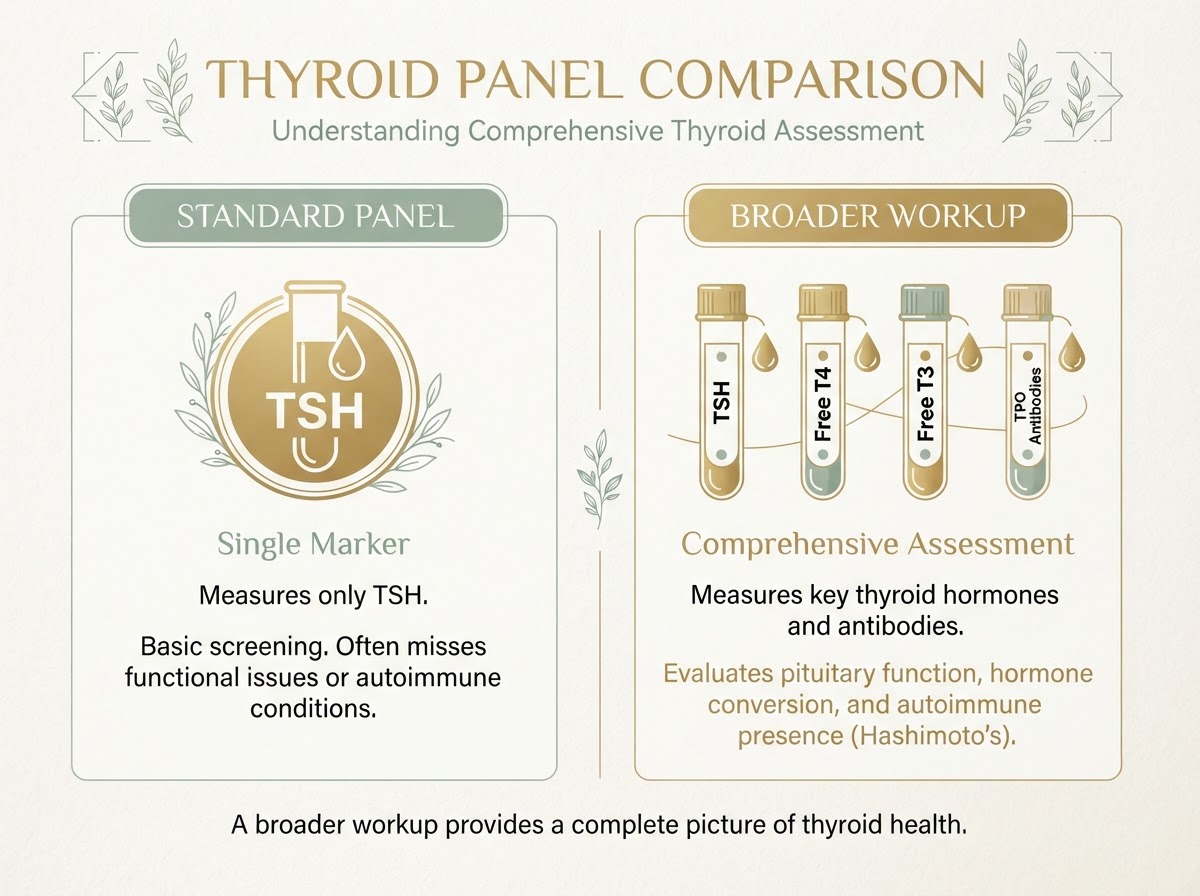
Most standard thyroid testing starts and often stops with one marker: thyroid stimulating hormone, or TSH. TSH is produced by the pituitary gland and rises or falls in response to how much thyroid hormone your body senses. It is a genuinely useful screening tool, and it is also just one signal in a longer chain.
A standard panel does not always include free T4 and free T3, the actual thyroid hormones circulating in your blood, or thyroid peroxidase (TPO) antibodies, which can flag an autoimmune thyroid process well before TSH moves outside its range. None of this means the first test was done wrong. It means it was designed to catch a specific, common pattern efficiently, not to map the entire thyroid picture.
Thyroid Symptoms, Normal Labs: Why the Gap Happens
Reference ranges are built from a broad population, so "normal" really means "not an outlier compared to most people," not "optimal for how you specifically feel and function." A TSH value can sit inside the standard range and still be at the edge of where it would ideally be for you. Add in the reality that thyroid function is influenced by nutrient status, stress, and other hormone systems, and a single number rarely tells the whole story on its own.
None of this is a criticism of the doctor who ran your first test. It is a different, narrower question than the one you are actually asking, which is why it can produce a technically accurate answer that still leaves you feeling unheard. You can read more about our thyroid condition page for additional context.
What a Broader Thyroid-Literate Workup Might Add
This is where a root-cause approach usually starts asking different questions, not because the first answer was wrong, but because it was incomplete for what you actually want to know.
- A fuller thyroid panel. Looking at free T4, free T3, and TPO antibodies alongside TSH, rather than TSH in isolation, to build a more complete picture of thyroid function and any autoimmune activity.
- Nutrient status. Several nutrients play a role in thyroid hormone production and conversion. Checking whether levels are genuinely sufficient for you, not just technically present, is often part of a broader workup.
- Related hormone patterns. The thyroid does not operate in isolation from adrenal and reproductive hormones, so a root-cause conversation often looks at how these systems interact rather than treating the thyroid as a standalone system.
- Your symptom history and timeline. When symptoms started, how they have changed, and what else was happening in your life at the time often points toward questions worth investigating that a lab value alone cannot answer.
What This Process Actually Looks Like
A visit typically starts with a real conversation, not a form. Your symptom history, your existing lab results, your sleep, stress, and diet, and what you have already tried, before anything new gets ordered. From there, additional testing may be recommended based on that conversation specifically, not as a default panel run on every patient.
Once results are in, the goal is to look at the fuller picture together: what the numbers show, what your body is telling you day to day, and what combination of factors might be worth addressing. That conversation happens alongside your existing physician, not around them. For a wider view of how this kind of testing is structured, see what a broader lab workup looks at.
If You're in San Diego
San Diego has one of the more health-literate populations in the country, and a lot of people here have already read enough to ask their doctor for "the full thyroid panel," only to be told the standard test was sufficient. That gap between what a patient wants investigated and what a short primary care visit has time for is a genuinely common reason people look for a second, more thorough conversation.
Because this practice operates as a virtual root-cause practice serving San Diego and the surrounding region, that second conversation does not require taking a morning off work to sit in a waiting room. The first step is simply a conversation about what you have already had tested and what, if anything, might be worth adding, not a commitment to a long program before you know whether it makes sense for you. Why fatigue and thyroid-like symptoms often overlap is worth reading if that is part of your picture.
What This Is Not
This is not a replacement for your endocrinologist, your primary care doctor, or your prescribed thyroid medication. If you are currently taking thyroid medication, that prescription and the relationship with the doctor who wrote it stay exactly where they are. A root-cause conversation works alongside that care, looking at contributing factors a shorter visit might not have had time to cover, never instead of it. Any change to a prescribed medication is a conversation to have with the doctor who prescribed it, not something to decide based on a broader lab panel alone.
It is also worth saying plainly that nobody can promise you a specific result. What a broader workup can offer is a more complete picture and an honest conversation about what it turns up.
Curious whether a broader thyroid workup makes sense for your situation?
Book a free discovery call and we will talk through what you have already had tested.
Book a Free Discovery CallFrequently Asked Questions
Why would I need more thyroid testing if my TSH already came back normal?
TSH is a useful screening marker, but a standard panel does not always include free T4, free T3, or thyroid antibodies. A broader workup looks at these additional markers together, asking a more complete question than a single TSH value can answer on its own.
Could something else be causing symptoms that feel like a thyroid problem?
Yes. Fatigue, temperature sensitivity, and weight changes can come from several overlapping systems, including nutrient status, stress, and other hormones. A root-cause conversation looks at your whole picture rather than assuming the thyroid is the only possible explanation.
Will this replace my endocrinologist or primary care doctor?
No. This works alongside your existing care. If you have a thyroid diagnosis or a prescribed medication, that relationship and treatment plan stay in place, and any change to your prescription is a conversation to have with the doctor who prescribed it.
Is this safe if I'm already taking thyroid medication?
Being on thyroid medication does not exclude you from a broader conversation about related factors like nutrients, stress, and other hormones. It does mean any medication decisions stay with your prescribing physician, and we will say so directly if something is outside what this practice addresses.
What if the broader panel does not find anything either?
That is a real possibility, and it is still useful information. Ruling things out can help redirect the conversation toward non-lab factors, like sleep, stress load, or other systems that often play a larger role than expected.
Information on this website is for educational purposes only and is not a substitute for medical advice, diagnosis, or treatment. A practitioner-patient relationship is not established until formally accepted by the practice.