Naturopathic vs. Functional Medicine Doctor: The Difference
Dr. Peter Wannigman, ND. Reviewed by Dr. Peter Wannigman, ND. Reviewed September 2026.
You have probably seen both terms in the same search results, sometimes on the same practice's website. Naturopathic doctor. Functional medicine doctor. Root-cause medicine. Integrative medicine. It is reasonable to wonder whether these are just different names for the same thing, or whether the difference actually matters when you are choosing where to book an appointment.
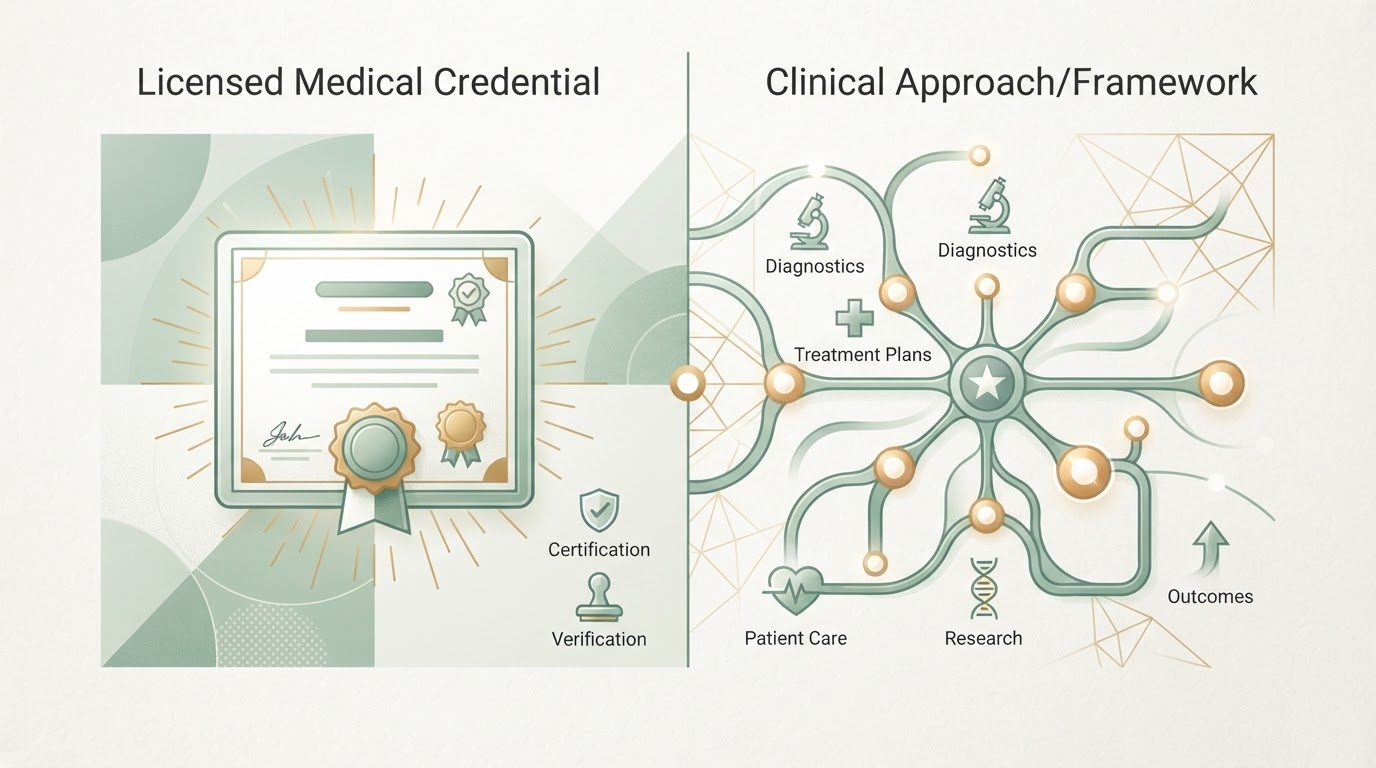
It does matter, a little, and the short version is this: naturopathic medicine is a licensed profession with a defined legal scope of practice. Functional medicine is an approach or framework that different kinds of licensed providers, including naturopathic doctors, medical doctors, and nurse practitioners, can choose to practice within. They overlap heavily in how they think about health. They are not the same thing, and knowing the difference helps you ask better questions before you book with anyone, not just here.
This matters most in one specific way: it tells you what to actually ask a provider before your first appointment. "Are you a licensed naturopathic doctor in this state?" has a yes-or-no, checkable answer. "Do you practice functional medicine?" is closer to asking about someone's philosophy of care, which is a fair question, but a different kind of question with a much less standardized answer.
What "Naturopathic Doctor" Actually Means
A naturopathic doctor, or ND, has completed a naturopathic medical degree program and, in states that license the profession, has passed board examinations and holds a state license. California is one of the states that licenses naturopathic doctors, and licensure comes with a defined scope of practice set by state law, not just a philosophy.
In California, a licensed ND can order lab tests and diagnostic studies, treat with diet, herbs, nutrients, homeopathic remedies, and physical modalities, and independently prescribe natural and synthetic hormones. Under supervision by a medical doctor, an ND can prescribe certain additional medications. An ND cannot independently prescribe Schedule I or II controlled substances, cannot independently interpret diagnostic imaging like an MRI or mammogram, and cannot perform major surgery. This is a licensed, regulated scope defined by state law, not an informal label a practice can adopt or drop depending on how it wants to market itself.
That last point matters more than it might seem. Licensure means there is a board, a set of examinations, and a legal scope of practice standing behind the title. If a practitioner says they are a naturopathic doctor in California, that is a checkable, specific claim, not a marketing description.
What "Functional Medicine" Actually Means
Functional medicine is not a license. It is a framework for thinking about illness, one that asks what underlying systems, digestive, hormonal, immune, metabolic, might be driving a set of symptoms, rather than treating each symptom as its own isolated problem. Because it is a framework rather than a credential, it can be practiced by naturopathic doctors, medical doctors, nurse practitioners, and others, with training that varies widely depending on who is offering it and how they were trained in it.
This is exactly why the two terms get confused. A naturopathic doctor who investigates root causes across multiple body systems is, in practice, doing functional-medicine-style work. The credential (ND) and the approach (functional medicine) are simply two different categories, one legal, one philosophical, that frequently show up together, often on the very same practice website.
There is also no single certifying body that governs who can call their practice "functional medicine," the way a state medical or naturopathic board governs licensure. Some functional medicine practitioners complete formal postgraduate training programs in the approach. Others use the term more loosely to describe a general philosophy of care. Because the term is not regulated the way a license is, it is worth asking any provider, regardless of their underlying credential, what specific training informs how they practice it.
Naturopathic Doctor vs. Functional Medicine Doctor: Where They Overlap
Where they overlap: both generally emphasize looking beyond a single symptom, both often use broader lab testing than a typical short primary care visit allows time for, and both tend to spend more time on history and lifestyle factors than a fifteen-minute conventional visit typically permits. Patients often choose either path for the same underlying reason: they want more time, more investigation, and a practitioner willing to ask what is driving a pattern of symptoms rather than treating each one separately.
Where they do not overlap: licensure and legal scope. "Functional medicine doctor" is not a protected title in the way "naturopathic doctor" is in a licensing state like California. Someone can describe their practice as functional medicine with a wide range of underlying credentials, from a medical doctor with additional training to a health coach without a clinical license at all. A licensed ND's scope of practice, by contrast, is set by state law and does not vary based on how the practice markets itself. Knowing this difference matters most when you are trying to understand exactly what a given provider is legally able to do, order, or prescribe for you, separate from how their website describes their philosophy.
How This Practice Combines Both
Dr. Peter Wannigman is a licensed naturopathic doctor in California, one of the state's inaugural licensed NDs when the profession was formally licensed there in 2004, and a former pharmacist. In practice, that means a root-cause, functional-medicine-style approach to evaluating symptoms, delivered within the legal scope of a licensed naturopathic doctor, including the ability to independently prescribe natural and synthetic hormones where clinically appropriate.
What that looks like day to day is a longer initial conversation than a typical short visit allows, a willingness to look at lab markers beyond the most commonly ordered ones when the conversation points that way, and treatment options that draw on nutrition, lifestyle, herbal and nutrient support, and hormone therapy where relevant, always working alongside any specialists or prescribing physicians already involved in your care.
The pharmacy background is also worth understanding in this context. It means the clinical reasoning about how a supplement, a nutrient, or a hormone might interact with an existing prescription draws on training in how medications behave in the body, not just training in natural therapies alone. That combination is part of what a root-cause conversation here looks like in practice, evaluating the whole picture rather than one input at a time. You can read more about our approach to naturopathic medicine and how it is structured.
What Neither Approach Replaces
Neither a naturopathic doctor nor a functional medicine framework is a substitute for emergency care, surgical care, or the ongoing management of a serious diagnosis by the specialist treating it. If you have a cardiac condition, cancer, or another diagnosis requiring coordinated specialist care, a root-cause conversation is meant to add a layer of investigation and support alongside that care, in coordination with your existing physicians, never as a replacement for it. The same is true for prescribed medication of any kind: changes to an existing prescription are a conversation to have with the doctor who prescribed it.
It is also worth being honest that neither term guarantees a specific outcome. Both describe a way of thinking about your health and a set of tools for investigating it, not a promised result.
If you are still comparing your options, our article on how to choose a naturopathic doctor in San Diego goes deeper on the questions worth asking any provider before you book. You can also learn more about our comprehensive wellness programs and how a root-cause evaluation fits into a longer plan.
Curious whether this approach fits what you are looking for?
Book a free discovery call and we will talk through your situation directly. It is 15 minutes, informational, and there is no obligation.
Book a Free Discovery CallFrequently Asked Questions
Is a naturopathic doctor the same as a functional medicine doctor?
Not exactly. Naturopathic doctor is a licensed credential with a legally defined scope of practice in states like California. Functional medicine is an approach that various credentialed providers, including naturopathic doctors, can practice. A naturopathic doctor can absolutely practice in a functional-medicine style, which is why the two terms are often used together.
What is naturopathic medicine, specifically?
It is a licensed system of medicine that, in California, allows a doctor to order lab testing and diagnostic studies, treat with diet, herbs, nutrients, and physical modalities, and independently prescribe natural and synthetic hormones, within a scope of practice defined by state law.
Do I need a referral to see a naturopathic doctor or a functional medicine practitioner?
Generally, no referral is required to book an initial conversation, though this can vary by insurance plan if you intend to seek reimbursement. A free discovery call is a low-commitment way to ask this specific to your situation.
Does either of these replace my primary care doctor or specialist?
No. Both are meant to work alongside your existing medical care, not instead of it. If you have a diagnosed condition or a prescribed medication, that relationship and treatment plan stay in place, and any changes are a conversation for you and your prescribing physician.
Is one of these more legitimate than the other?
They are different things being compared as if they were the same category. Naturopathic licensure is a legal credential with defined scope. Functional medicine is a clinical approach. Asking which one is "more legitimate" is a bit like asking whether a license is better than a philosophy. What matters more is the specific provider's training, scope, and how they explain their reasoning to you.
Information on this website is for educational purposes only and is not a substitute for medical advice, diagnosis, or treatment. A practitioner-patient relationship is not established until formally accepted by the practice.